What Are We Living Through?
We are living through turbulent times. That is what everybody feels and sees. There is no need to list all the issues that create these feelings of turbulence every day.
However, in order to understand how we should respond to this turbulence, it is important to see not only the daily events that generate them but also the long-term tectonic shifts that are taking place globally and across the European continent. These shifts are the underlying causes of the turbulence and anxiety that we experience each day.
Some of these tectonic shifts are of such a magnitude that, as global history shows, they occur only once in a millennium and are now happening again. Others will reshape the security architecture of the European continent and the mentality of Europeans, which has been shaped over the past eighty years. Still others are only beginning to emerge but will have a profound impact over the coming decades, extending to the end of this century.
All of these developments are part of the landscape that we need to understand in order to navigate the whole European continent through the turbulent and unprecedented geopolitical changes of the twenty-first century.
Tectonic Shifts of the Twenty-First Century
Millennium Shift: China and India Rising
It would be a serious mistake for Europeans not to recognize that, by the end of this century, China has every possibility of becoming the world’s largest economy (Council on Foreign Relations, The Future of American Strategy, 2026):
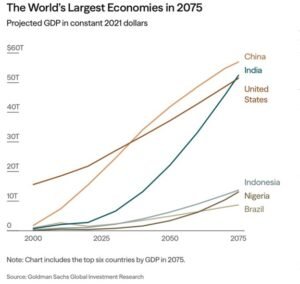
China has every right to achieve such a status. We need to confront today’s unfair Chinese economic practices, and we must be prepared to defend the global order against any aggressive Chinese attempts to seek not only global economic leadership but also geopolitical dominance. However, one fact should remain clear: if there are no major global or domestic Chinese economic or political crises, China is likely to become the world’s number one economy by the end of this century.
India, as the world’s largest democracy and most populous nation, will follow a similar path and become the world’s second-largest economy. Definitely, India will also seek to play a much more significant geopolitical role in global affairs.
Such a development, with China and India assuming global economic and geopolitical leadership, will bring about tectonic shifts opposite to those that occurred almost six hundred years ago. Following Columbus’s voyages, Europeans became a global power and, as a result, developed rapidly growing economies. This was the reason why the West eventually overtook the East economically and geopolitically, even though China and India, at that time, were economically much stronger than medieval Europe before the Age of Discovery (Ian Morris, Why the West Rules—For Now: The Patterns of History, and What They Reveal About the Future, 2011).
The Next 70 Years: The Future of Geopolitical Players
In 2027, the European Union will celebrate the 70th anniversary of the Treaty of Rome, through which the European Economic Community was established in 1957. In 1993, it was renamed the European Union.
While celebrating the 70th anniversary of the most successful European project, it is also an appropriate occasion to consider what the next 70 years may look like for Europe and the world.
During the next 70 years, many developments may shape global trends, including major wars, economic crises, the impact of climate change, uncontrolled migration, and other unforeseen events.
These developments are difficult, if not impossible, to predict. However, it is possible to assess the future of the major geopolitical players by assuming that no major global catastrophe will occur and that current long-term trends will continue.
From this perspective, we can expect that the next 70 years of the European Union will be defined by the same internal trends that have characterized its first 70 years: a gradual and natural evolution toward greater unity and consolidation.
Externally, the EU’s geopolitical position will depend heavily on the future trajectories of the other major geopolitical players. Some of them are Europe’s partners, others are competitors, and some are currently its adversaries.
Let us consider the future of five major geopolitical actors: China, India, the United States, the European Union, and Russia.
As discussed above, the millennium-scale tectonic shift taking place over the course of this century is likely to elevate China and India to positions of global economic and geopolitical leadership. Demographic trends and market forces will drive this development. There is little that can prevent such a transformation.
If China and India return to global economic leadership – as they held before the Age of Discovery – the United States will be pushed from first to third place in the global rankings. For Americans, this may prove psychologically challenging, requiring them to adapt to the reality that Pax Americana has come to an end.
The slogan “Make America Great Again” is the signal that nostalgia for the glorious times of American global leadership is starting to play a more and more important role in American political and geopolitical mentality. Nervousness of the United States about its position as a global geopolitical player can have many different, and sometimes unpredictable turns and impacts, but always there is the hope that Americans are rational people and they will manage to overcome emotions and frustrations, which are the usual feature of the former leader, who lost its leadership.
The rise of China and India is unlikely to have the same psychological impact on the European Union. The main reason is that even today, the EU is generally regarded as the world’s second- largest economic power after the United States. Ending the century in fourth place rather than second may therefore be less traumatic for Europe. Consequently, the EU’s future will be shaped less by competition for global leadership and more by its own internal evolution through evolutionary enlargement, evolution of deeper political integration, and greater unity.
The European Union’s development can be influenced much more directly by developments in its immediate neighbourhood—particularly Russia. Among the five major geopolitical actors, Russia is the only one whose future by the end of the century remains almost impossible to predict.
If Russia continues under the policies of Vladimir Putin, or of leaders pursuing similar policies, and remains isolated from the world’s major economies and markets, it is likely to experience a prolonged domestic decline. Such a trajectory could result in increasing internal instability, more aggressive domestic and foreign policies, and even the possible collapse of state order.
At the same time, before the end of the century there is also the possibility for Russia to transform itself back to normality. Russia may eventually return to a more normal political trajectory. Historically, such transformations have often followed major national disasters, including military defeat. As Russia’s history demonstrates, these changes have usually originated within the political elite in or around the Kremlin rather than through popular revolution.
A Once-in-a-Century Change: A New Security Architecture for Europe
Europe’s current security architecture was established in 1949 with the creation of the North Atlantic Treaty Organization (NATO). It was based on the principle that the United States would assume primary responsibility for defending Europe against the threats of Soviet Union’s conventional and nuclear military power.
Within this framework, European countries played a secondary role in collective defence. Europeans accepted this division of responsibilities and invested in defence primarily to maintain their place within the transatlantic security system and to participate in discussions concerning American security guarantees (Henry Kissinger, World Order, 2014).
Following the end of the Cold War, it appeared that both NATO and Europe could benefit from a peace dividend. Since the Soviet Union had collapsed it looked like that the major goal of NATO to defend Europe against the military might of the Soviet Union also disappeared. NATO shifted its focus away from territorial defence of Europe toward international operations, including missions in the Balkans, Afghanistan, and Iraq. This strategic shift was reflected in NATO’s 2012 Strategic Concept.
Russia’s annexation of Crimea in 2014 demonstrated that this change in doctrine had been premature. However, it took Russia’s full-scale invasion of Ukraine in 2022 for NATO to begin restoring the institutions, capabilities, and doctrines necessary for the territorial defence of Europe.
At the same time, the United States started to increasingly shift its strategic attention toward China and the Indo-Pacific region, where the most significant geopolitical developments of the twenty-first century are expected to occur.
Washington has therefore made a clear and rational request: Europeans should assume primary responsibility for the conventional defence of Europe, while the United States will stay in a secondary role and continues to provide nuclear deterrence.. This concept is often described as “NATO 3.0.” Europe has little alternative but to accept this new division of responsibilities. And to invest into it..
It’s obvious, that for the next 10 to 15 years, the principal strategic task for Europeans will be to build a new security architecture of Europe based on NATO, but also on much more of European sovereignty in the matters of it’s own security.
This represents the most profound transformation of European security in nearly a century. Europe faces a double deep transition. First, European defence structures and NATO doctrine must return to the most important principles of territorial defence. Second, territorial defence of Europe will need to be transformed from transatlantic collective defence of Europe towards much more of European collective defence of Europe.
Are We Ready for 2100?
On the Importance of Long-Term Thinking
Following Russia’s full-scale invasion of Ukraine, and especially after the recent changes in the United States’ national defence strategy, the European Union has done much to strengthen its own defence capabilities. The sense of urgency was reinforced by public assessments from the intelligence services of several Member States, all of which delivered the same message: Russia could be ready to launch military aggression against EU Member States before 2030.
In response, the EU adopted and is implementing the Defence Readiness 2030 agenda. Significant financial resources have been allocated, and the rapid ramp-up of Europe’s defence industry is now clearly visible.
However, when preparing to defend against long-term threats – including those arising from global tectonic shifts – the European Union needs not only an emergency plan extending to 2030 but also a long-term strategy to prepare for challenges that may become fully visible only decades from now but can already be anticipated today.
Such preparations must begin immediately because they require the political class to develop a long-term mindset and the ability to look beyond today’s challenges toward those that are likely to shape the remainder of this century. Developing the skills to look at the long-term perspective takes time. They cannot be created by government decree or European regulation. It requires a profound cultural change in the mentality of Europe’s political leadership.
For some reason, it appears that Americans—and especially the Chinese—have developed this long-term strategic mindset more successfully than Europeans.
China, India, the United States, and the European Union: Is the “Westernization” of the West Possible?
When looking at the long-term future, we first need to distinguish between developments that depend on our own decisions and those that do not. Where change does depend on us, our task is not to resist history but to adapt intelligently to it.
For example, Europe will not be able to prevent China and India from becoming the world’s two largest national economies before the end of this century. However, today we can – and must – counter China’s unfair economic practices through effective anti-coercion measures.
As China moves toward becoming the world’s leading economy, it will naturally seek a greater geopolitical role. India is likely to do the same. This would not be the first time that global leadership has shifted. Before the era of American leadership, the United Kingdom occupied that position. History is responsible for such transitions, and it would be a mistake to attempt to resist the flow of history.
History, however, also places a tremendous responsibility on new global leaders: the responsibility to preserve global world order. Sometimes emerging powers need to learn the lesson that the majority of the global community will not tolerate their aggression against smaller neighbours. Until this lesson is learned, aspirations for global leadership may prove both costly and painful.
What should Europe’s response be to these long-term geopolitical shifts that are already creating growing turbulences?
As Europe gradually moves toward fourth place among the world’s largest economies, it will have only limited influence over this broader historical transformation. Even the United States alone may find it difficult to alter the trajectories of China and India. Nostalgia for past national greatness or strategic arrogance toward Europe will not help the United States to stop the tendency of going down from number one to number three in global rankings.
A greater European influence on the global economic and geopolitical leadership would be possible only if Europe and the United States increasingly acted as one, closely connected and interrelated strategic community. Combined, their common population, economic strength and technological capabilities will help the EU and US retain global leadership even at the end of this century.
Is such a development possible?
Although the dominant trend in the West today appears to be increasing nationalization of everything, it is possible that this will eventually give way to a new phase of Westernization – a growing recognition that only a united West can successfully compete with the rising powers of the East.
Europe should consistently support such a process. It should do so patiently, confidently, and strategically. This partnership would become even stronger if Europe will continue to be more independent in its security and defence matters and will return to a path of stronger economic growth.
On the Normalization of Russia: A Responsibility of the European Union
If Europe can play only a limited role in moderating the rise of China and India, and only if Westernization will happen, it can nevertheless play a decisive role in mitigating the challenge of the unknown future of Russia.
Europe can make an impactful contribution to the possibility of Russia’s eventual internal transformation back into a normal state – a country that is no longer aggressive toward either its own citizens or its neighbours.
Europe must believe that such a scenario with Russia is possible over the long term because it represents the only sustainable foundation for lasting peace on the European continent.
This transformation is unlikely while Vladimir Putin remains in power. That is today’s reality. Without the transformation of Russia, all other scenarios will be dangerous and will bring even greater security threats to Europe: an unconditional “Reset 2.0” with Putin; a Russia that continues along its current path while becoming an economic and social black hole; or the collapse of Russian statehood. Each of these scenarios would create more aggressive Russia, which will become more desperate and wild.
Above all, Europe must understand that it would be a serious mistake to remain indifferent to Russia’s future or to assume that the European Union has no influence over Russia’s long-term process of Russia’s transformation.
Yes, the European Union cannot and should not attempt to engineer political change inside Russia. However, it is in Europe’s vital strategic interest to encourage internal developments that would eventually lead Russia back toward a non-aggressive and responsible normality.
The European Union possesses three important instruments that could inspire both Russian society and future Russian leaders to pursue such a transformation.
The first is continued European support for Ukraine’s military success. Russians must understand that imperial nostalgia leads not to national greatness but only to millions of personal tragedies, for Russians, not only for Ukrainians.
The second is sustained European support for Ukraine’s economic and social success through its integration into the European Union, as it happened with Central European and Baltic states’ successful integration after the Cold War. Such integration of Ukraine can start from its military integration, which is in the vital interest of Europe. Success of a prosperous, democratic and European Ukraine could eventually inspire Russians to seek a similar path for their own, normalized country, with reestablished normal relations with Europe.
The third instrument is a clear long-term European strategy defining future EU-Russia relations once Russia has returned to normality. Europe should make it clear that renewed access to European markets, trade, and economic cooperation will become possible only after Russia fully meets the political conditions of becoming a normal country: a peaceful and responsible state.
The European Union can help create the conditions for Russia’s eventual transformation back to normality. In doing so, it would fulfil one of its greatest strategic responsibilities toward future generations by contributing to lasting peace on the European continent. Such a peace will be possible only if Russia itself changes. The alternative – a permanently aggressive Russia and the permanent threat of Russia to the security of Europe.
The greatest disservice Europe could do towards the long term perspective of sustainable peace on the European continent would be to pursue a “Reset 2.0” with Putin or with an unchanged Russia. The temptation to do so may become particularly strong after a ceasefire or peace agreement between Russia and Ukraine. Such a mistake would undermine possibilities for Russia’s own long-term self-transformation and ultimately make Europe less secure.
Europe therefore needs an ambitious and realistic long-term strategy for achieving sustainable peace on the European continent – with Ukraine fully integrated into the European Union and with a Russia that has genuinely returned to peaceful normality.
The Power of Ambition: European Strength and Independence in Defence
Mitigating the rise of Chinese and Indian economic and geopolitical leadership, or helping to facilitate Russia’s return to normality, are tasks of historic significance. They concern transformations of a magnitude that occur only once in a millennium.
These global changes will create prolonged turbulences of instability and uncertainty. To respond effectively, the European Union must become powerful and independent.
Above all, Europe must become powerful and independent in the fields of defence and security. While remaining a strong European pillar within NATO, the European Union must be prepared to assume primary responsibility for the conventional collective defence of Europe.
The future security architecture of Europe will rely much less on the transatlantic model established in 1949 and much more on Europe’s own capacity to provide for its defence.
After more than eighty years of a predominantly transatlantic defence system of Europe, Europe now needs to build a truly European system of collective defence of Europe.
Only a Europe that is strong, confident, and capable of defending itself can become a genuine strategic partner of the United States in a renewed process of “Westernizing” the West and in achieving sustainable peace on the European continent.
European Ambition: More Than the Sum of National Ambitions
This is an ambitious, urgent, and historic task for Europeans.
Once in a century, European leadership is called upon to respond to challenges of this magnitude. No one else can accomplish this task on Europe’s behalf.
Europeans must therefore genuinely Europeanize the way of their thinking. They need to recognize that a European approach – not fragmentation into national silos – is what will enable Europe to become strong and up to the tasks of this century, – once in a millennium and once in a hundred years tasks.
European institutions, such as the European Parliament and the European Commission, are already thinking in European terms. They do not suffer from a lack of “Europeanization.” Citizens, experts, and many business leaders are increasingly demanding European power – in defence and in economy.
It is now time for national governments to overcome the temptation of excessive “nationalization.” Giving priority to” national” should not mean indifference of national leaders to the “European”.
National interests themselves will suffer if Europe as a whole is weakened.
The European Council should become the collective leader of European ambition rather than the last defender of a status quo that is increasingly incompatible with the tectonic changes of the twenty-first century.
What Are We Living Through?
We are living through a century of profound turbulence.
We are witnessing the crisis of the status quo.
Jean Monnet once observed that the European community would be built through crises and would become the sum of the solutions adopted in response to those crises.
Until now, this formula has accurately described the evolution of the European Community and later the European Union. Each successive crisis has made Europe stronger, more united, with new common institutions and policies.
The current crisis of the status quo should lead to the same result.
The European Union will emerge from this period stronger and more united in all those areas where the existing status quo has become an obstacle to further progress.
We should not fear this organic evolution of the European Union.
On the contrary, we should welcome the opportunity to live through the period in which Europe matures and assumes primary responsibility for its own future.
Not only in defence.